Self-consumption versus feeding back to the grid
Why the maths changed in Belgium and the Netherlands, and what to do about it
There used to be a simple answer to this question. For about fifteen years, owners of solar panels in most of north-western Europe operated under what was effectively a virtual battery agreement: every kilowatt-hour you sent to the grid in summer counted as one you could pull back in winter, at the same price. The technical name was net metering, salderingsregeling in Dutch, terugdraaiende teller in Flemish, and it was a beautiful arrangement while it lasted. You did not need to worry about when you produced or when you consumed. The annual balance was all that mattered.
That world is now ending or has already ended, depending on where you live. The economics have flipped, often quite suddenly, and a kilowatt-hour you use yourself is now worth several times what you get for sending it back. This article walks through what changed, why, and what it means for someone who already has panels or is about to install them.
What the numbers actually look like in 2026
Let's make this concrete. In Belgium, the prevailing retail electricity price for a residential customer sits around €0.27 per kWh in 2026, sometimes higher depending on the energy contract. The compensation you receive for solar power you inject into the grid, the so-called injection tariff, hovers between €0.03 and €0.05 per kWh. The exact ratio shifts with energy markets, but the structural picture has been stable for several years now: self-consumed solar is roughly five to six times more valuable than exported solar.
In the Netherlands, the famous salderingsregeling will end on 1 January 2027, after a political back-and-forth that lasted over a decade. From that date, surplus solar power will be remunerated at a much lower compensation rate negotiated with each energy supplier, somewhere in the same €0.03 to €0.10 per kWh range as Belgium, while electricity drawn from the grid still costs roughly €0.30. The Dutch market has spent the last two years adjusting in advance, with new solar installations dropping by 72% from the 2023 record and home battery sales rising fast.
In Belgium the picture is fragmented across the three regions. Flanders introduced a capacity-based grid tariff in January 2023, where the highest 15-minute peak you reach in any given month becomes part of your bill. Wallonia rolled out a new time-of-use tariff in January 2026 with five time slots and three price levels, automatic for anyone with a digital meter. Brussels is the last region still operating with traditional net metering, but the wind-down has been announced for 2027 to 2028. Across the border in Germany the Einspeisevergütung has been declining for years, and France's various tarifs d'achat are now well below retail prices in most contracts.
The trend is universal even where the timing differs. Whether you live in Antwerp, Amsterdam, Aachen or Avignon, the assumption that "the grid will pay me back fairly for my surplus" is no longer safe. The grid will take your surplus, but it will pay you a fraction of what it charges you to use the same kilowatt-hour an hour later.
Why this happened
It is tempting to read these reforms as governments turning hostile to solar, but that is not really what is going on. The original net metering schemes were designed when residential solar was rare, expensive, and needed a strong incentive to take off. They worked spectacularly well. Belgium and the Netherlands now have some of the highest residential solar densities in the world, and a typical sunny day in May produces more power across these grids than the country can comfortably absorb at midday.
When too much solar production hits the grid at the same time, several things happen. Wholesale electricity prices crash, sometimes turning negative, meaning the grid actually has to pay big consumers to take electricity off its hands. Local distribution networks experience reverse flow problems, voltage rises, and inverters in entire neighbourhoods start switching themselves off as a protective measure. The grid was designed to deliver electricity from a few large power stations to millions of homes, not to receive it back from a million individual rooftops at the same time on a Sunday afternoon when nobody is at home to use it.
The new tariff structures are an attempt to nudge behaviour. If self-consumed power is worth a lot more than exported power, owners will naturally try to use their production when it happens. If peak grid imports are punished with capacity tariffs, owners will stagger their heavy loads. If exports are paid by the half-hour at fluctuating market prices, owners will eventually buy batteries or smart appliances that decide when to charge and when to wait. The aim is not to punish solar owners. The aim is to flatten the duck curve and keep the grid stable as renewables push past 50% of the energy mix.
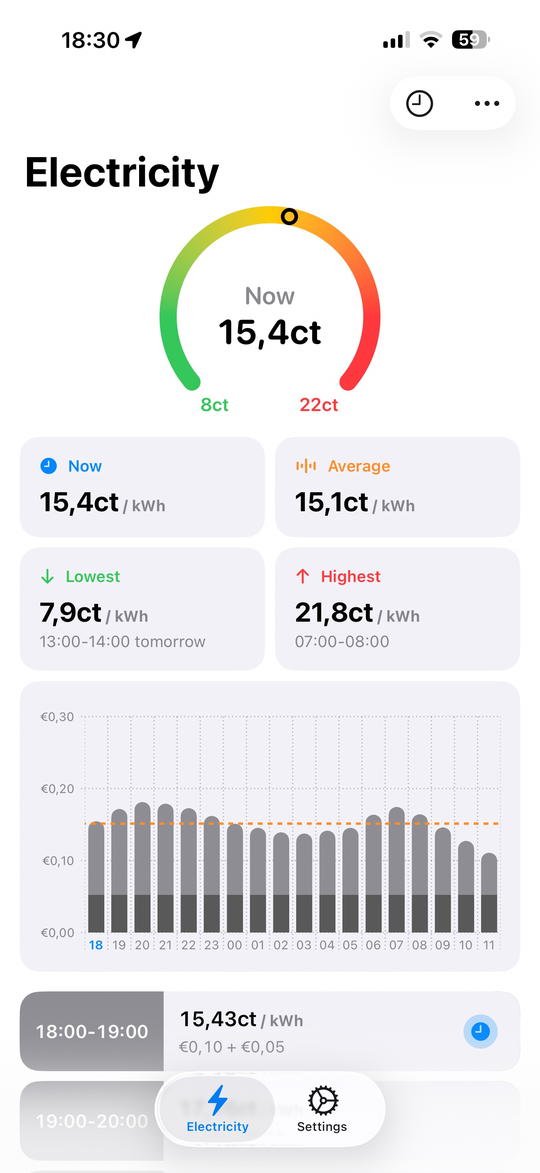
Whether this is the right way to solve the problem is a separate debate. The point for individual solar owners is that the rules of the game have changed, and the smart move is to play by the new rules.
What "high self-consumption" actually means
Self-consumption is the percentage of the solar electricity you produce that you use yourself, rather than exporting it. A household that produces 5,000 kWh per year and consumes 2,000 of those kWh directly has a 40% self-consumption rate. The same household producing the same 5,000 kWh but consuming 3,500 directly has 70%.
Without changing your panels, your roof, or your electricity bills, the number that matters most for your annual savings is this percentage. And that percentage is driven by behaviour, appliances, and timing, not by hardware.
Typical Belgian and Dutch households without specific intervention sit somewhere between 25% and 35% self-consumption. With deliberate effort, the same households often reach 50% to 60%. With a battery, the number can climb to 70% or 80%, sometimes higher. Each percentage point matters: an extra 10% of self-consumption on a 5,000 kWh annual production, valued at €0.27 instead of €0.05, is roughly €110 per year that stays in your pocket rather than going to the grid for almost nothing.
How to push your self-consumption higher
Some of this is obvious in hindsight. Some of it requires a little more thought.
The dishwasher, washing machine and dryer are the easiest wins. These are large, schedulable loads that do not care whether they run at 11am or 8pm, and almost every modern model has a delay-start function. Setting them to run when the sun is on the roof rather than when you happen to be home turns directly into self-consumed kilowatt-hours. The same logic applies to charging an electric vehicle: a car plugged in between 9am and 4pm can absorb several kilowatt-hours of solar power per hour straight from the panels, rather than from the grid at night.
Heat pumps are the bigger lever. Modern heat pumps for space heating and domestic hot water can be configured to do most of their daily work during sunlight hours, particularly the hot water boost, which acts as a de facto thermal battery. A well-tuned heat pump and hot water tank can absorb 5 to 15 kWh per day of solar production, all of it directly from your roof, all of it valued at retail rather than injection rates.
After that, things get more technical. Home batteries are the headline option, but they are not always the right answer. A 5 kWh battery in Belgium currently costs somewhere between €3,500 and €5,500 installed, and the payback depends heavily on your existing self-consumption rate, your tariff structure, and how much sun your roof actually catches in winter. The number for recent Flemish installations suggests that prosumers above roughly 30% self-consumption already break even without a battery under the new tariffs, and a battery shifts the curve further only if you can use it for daily cycling. A battery that sits half-charged most of the time is a battery that is not earning its keep.
Smart energy management systems sit between behaviour and hardware. Devices like Home Assistant with the right integrations, or commercial offerings like Smappee, Solenco or the various inverter-bundled solutions, can automatically switch loads on and off based on real-time solar production. They are useful, sometimes worth the investment, and almost always more rewarding than a battery on a per-euro basis if you have the appliances to control. They do require some technical comfort to set up well.
Where data comes in
All of this assumes you actually know what your self-consumption rate is. Surprisingly few solar owners do, even years into ownership, because the manufacturer apps that ship with most inverters are often vague or only show you the production side.
This is one of the practical reasons platforms like PVOutput.org matter, and one of the reasons HelioPeak exists in the first place. Once you upload both production data and consumption data, the percentage falls out of the math automatically, and you can see how it changes over the year. A summer self-consumption rate of 70% with a winter rate of 30% averages to 50% on paper, but the experience of those two seasons is wildly different in terms of when you should run heavy loads. Tracking it month by month is the only way to know what your installation is actually doing.
A quieter conclusion
Twenty years ago, the question of self-consumption versus grid feed-in did not really exist. Today it is almost the only question that matters. Producing solar power is no longer the hard part. The hard part is using it well, at the right moment, with the right appliances, in the right order through the day. The reforms across Europe have made the consequences of getting this right more visible, but they have not changed the underlying physics. They have merely made the timing of consumption something you can no longer afford to ignore.
For households that pay attention, the new tariff structures are not a punishment. They are an opportunity to reduce a household's electricity bill more effectively than the old net metering ever did, simply by aligning consumption with production. The first step is knowing where you stand. The rest follows from there.