Home batteries in 2026
Fixed wall-mounted, plug-in alternatives, and what actually pays back
Five years ago, a home battery was a niche product for early adopters with deep pockets and a tolerance for fiddly software. In 2026, it has become one of the central questions in any conversation about residential solar. The reasons are the ones we covered in the Self-consumption versus feeding back to the grid article: with net metering being phased out, capacity tariffs in place, and the value of self-consumed solar climbing while the value of injected solar collapses, the case for storing your own electricity instead of donating it back to the grid has finally become a numbers conversation rather than an idealism conversation.
I happen to have skin in this game from two angles. The main residence runs a Sonnen Battery 10, installed in January 2024, a wall-mounted, high-end, fully integrated system with German engineering, an installer-managed setup, and the price tag that goes with all of that. The second property runs three Marstek Venus E v3 plug-in batteries, totalling 15.36 kWh, wired by an electrician onto a dedicated 16A circuit so they can output their full 2,500W instead of the default 800W plug-and-play limit. Two installations, two budgets, two completely different philosophies. Both work. Both have surprised me, in different directions.
This article walks through the three main categories of home battery in 2026, the trade-offs between them, and what I have actually learned from living with both ends of the market.
The three categories
Before getting into specific products, it is worth understanding that home batteries in 2026 fall into three broad architectures, and the differences between them are bigger than the marketing usually suggests.
Hybrid inverter integrated. A hybrid solar inverter that handles both panels and battery in a single device. SolarEdge Energy Bank, Fronius GEN24 Plus with BYD HVS or LG modules, Huawei FusionSolar, GoodWe ET, Solis hybrid, Victron MultiPlus-II. The battery and the inverter are designed to talk to each other natively, and the whole stack is sold as one solution. This is the cleanest path when you are installing solar and battery at the same time. It is more constrained when you want to add a battery to an existing inverter that does not already support one.
AC-coupled wall-mounted. A standalone battery system with its own built-in inverter, connected to the home's AC wiring rather than to the solar inverter. Tesla Powerwall, Sonnen, sonnenCore+, sonnenEvo, Enphase IQ Battery, Pylontech with a hybrid inverter. These work with any existing PV system, because the battery does not care which inverter is on the roof. They are larger, heavier, and require professional installation, but they are also more flexible and typically come with longer warranties and better backup-power features.
AC-coupled plug-in. The newcomer category that has appeared properly in the last two years. Marstek Venus E, Zendure SolarFlow, Anker Solarbank, EcoFlow Stream. These are smaller standalone batteries (typically 2 to 5 kWh per unit) with a built-in micro-inverter, designed to plug into a regular wall socket or into a dedicated circuit in the fuse box. The pitch is plug-and-play installation, low cost per kWh, modular expansion, and no need for a hybrid inverter. The execution, as we will see, varies significantly between brands.
Each architecture is right for different scenarios. Let me work through what each one feels like to live with.
The wall-mounted experience: Sonnen Battery 10
The Sonnen Battery 10 is the German company's mid-range residential offering, installed at the main residence in January 2024 with around 10 kWh of usable capacity (10.4 kWh nominal). It uses LFP chemistry, weighs around 165 kg, and sits in a dedicated indoor location like a small white wardrobe. The installation was done by a certified Sonnen installer over the better part of a day, with a Sonnen energy meter wired into the fuse box and the battery commissioned through the Sonnen cloud.
The honest verdict, after two years of daily use: it is excellent, and it is expensive. Those two observations are not unrelated.
What the high price buys you, beyond the hardware itself, is an integrated experience that just works. The battery silently charges when the panels produce more than the house consumes, and discharges when the house consumes more than the panels produce. There is no configuration to tune, no app to babysit, no edge cases to worry about. The Sonnen energy manager handles everything in the background, with sensible defaults and predictive logic that learns the household pattern over weeks. After two years, the round-trip efficiency is still in the high 80s, the capacity has shown no measurable degradation, and the system has needed zero maintenance.
The German engineering shows up in details that are hard to put a price on. The fan is essentially inaudible. The thermal management has handled both winter cold and summer heat in an unheated technical room without ever throttling. The firmware updates have been regular and flawless, arriving roughly every two to three months with incremental improvements and never causing an outage. The Sonnen app is functional, if a bit dated visually, and shows production, consumption, battery state, and grid flow in real time, with a clear historical view going back to installation.
Then there is the warranty, which is the single best argument for Sonnen even at the premium price. The Sonnen warranty covers 10 years or 10,000 cycles with at least 70% capacity retention at end of warranty. The 10,000-cycle figure is roughly double what most competitors offer, and translates to 27 years of full daily cycling before the warranty cycle limit is reached. In practice, the calendar limit of 10 years arrives first, but knowing the cell chemistry is rated for that many cycles is its own kind of reassurance. Most lithium batteries on the market in 2026 are rated for 4,000 to 6,000 cycles. The Sonnen rating is genuinely unusual.
The downside is the price. A Sonnen Battery 10 installed in Belgium in 2024 cost somewhere around €10,000 to €13,000 all in, depending on the installer, the integration work, and any backup-power circuitry. That works out to roughly €1,000 to €1,300 per usable kWh, which is two to three times what some competitors charge per kWh. The justification has to come from the long warranty, the integrated experience, and the resale-grade quality of the German manufacturing. For a household that plans to stay in the same property for fifteen or twenty years, the maths work out. For a household that might move in five years, the premium is harder to defend.
The other downside is that Sonnen is a closed ecosystem. The cloud, the app, the energy manager, the meter, the modules, it is all Sonnen. There are community projects that read the battery's local API for Home Assistant integration, and they work, but you are clearly off the supported path. The trade-off is the opposite of the platform-independence story we have been telling for solar monitoring: with a Sonnen, you accept the lock-in in exchange for the polish.
The plug-in experience: three Marstek Venus E v3 units
The Marstek setup is in a different property, with a different philosophy: get as much storage as possible for as little money as possible, and put up with the rougher edges that come with that. The installation became possible only after Marstek's official Synergrid homologation in Belgium, which happened on 8 August 2025 for both the Venus C and Venus E models. Before that date, the batteries could not legally be connected to the Belgian grid. The system at the second property has been running since autumn 2025, so the operational experience is several months rather than several years, short enough to note caveats, long enough to draw meaningful conclusions.
The numbers tell the basic story. Each Marstek Venus E v3 is a 5.12 kWh LiFePO4 battery with a built-in 2,500W bidirectional inverter, sold for around €1,050 plus the mandatory Belgian Bebat environmental levy of €167.62 excluding VAT. Three units, professionally installed by an electrician onto a dedicated circuit with 2.5 mm² wiring and a 16A breaker, total around €3,900 to €4,500 in hardware plus a few hundred euros in installation labour. For 15.36 kWh of storage and 7.5 kW of combined output, that is roughly €280 to €300 per usable kWh installed, about a quarter of the Sonnen cost per kWh.
The "plug-and-play" marketing needs a small asterisk in 2026, and the asterisk is worth understanding. Out of the box, a Marstek Venus E v3 is limited by Belgian regulations to 800 W output when plugged into a regular wall socket. To unlock the full 2,500 W per unit, it has to be hard-wired onto a dedicated circuit with the appropriate protection. This is not a do-it-yourself job in Belgium, and it does not invalidate the warranty as long as a qualified electrician does the work. The cost difference is small (a few hundred euros for the electrician), but it transforms the battery from a marginal supplementary device into a real storage system that can carry household evening loads.
The hardware is, for the price, quietly impressive. LFP chemistry with a rated 6,000+ cycles, IP65 weather rating so the batteries can sit outdoors under an overhang, a 10-year warranty (whose enforcement is, frankly, untested at scale for such a new brand, but the paperwork exists), four communication interfaces including native LAN with Modbus TCP on the v3 generation, and a build quality that surprises people who have only seen the price tag. The batteries are silent under normal operation, generate minimal heat, and look reasonably industrial rather than cheap.
Where the Marstek story gets honest is the software. Marstek's own app is functional but visibly rushed: the company's software clearly prioritised hardware over polish at launch, and the app has been catching up through monthly firmware updates ever since. Things have improved noticeably with each release, and the trajectory is the right one, but the experience as of mid-2026 is still that the app occasionally hangs, the cloud occasionally loses connection, and the local API exposed by the firmware regularly blocks new connections for reasons that are not always clear. This is the cost of buying a relatively new product from a Chinese manufacturer that prioritised market entry over software completeness.
The workaround, for anyone running Home Assistant, is to bypass the official cloud entirely and read the batteries over Modbus TCP directly. The v3 generation supports this natively over its built-in Ethernet port, no RS485-to-WiFi gateway needed, which was a requirement on the v2 generation. There are several open-source Home Assistant integrations for the Venus E series, of varying maturity, and the one I settled on after some experimentation provides full read and write access to all the registers that matter: state of charge, charge and discharge power, work mode, energy counters, alarm flags, and the configurable power limits. The Modbus approach is, in practice, more reliable than the official local API. The official API blocks regularly when the cloud syncs are happening; Modbus does not care about the cloud and just answers.
The result, once Home Assistant is in the loop, is a setup that probably works better than Marstek's own app intends. Custom integrations like Marstek Venus Energy Manager add features the manufacturer does not yet ship: predictive grid charging based on tomorrow's solar forecast, dynamic power management across multiple batteries with state-of-charge load balancing, zero-export PD controllers, and time-of-use arbitrage for households on dynamic price contracts. None of this is supplied by the manufacturer. All of it is community-built. For technically inclined users, the platform is more capable than the brand markets. For non-technical users, the experience is a notch below what a polished commercial product would deliver.
Side-by-side: what each one is actually for
Setting aside any single brand, the categories themselves have different jobs.
Wall-mounted integrated batteries like Sonnen are right for households that want a single, polished product, professional installation, the longest warranties on the market, robust backup-power capability, and a setup that needs zero attention after commissioning. The price reflects all of that. They are well suited to main residences where the battery will cycle daily for fifteen to twenty years, where the household values reliability over tinkering, and where the budget can absorb a four-figure premium per kWh.
Plug-in batteries like Marstek (and the various Zendure and Anker equivalents) are right for households that want maximum kilowatt-hours per euro, who are comfortable installing and managing the system themselves or with a friendly electrician, and who do not need backup power. They are particularly well suited to adding storage to existing solar installations without ripping out the inverter, to second properties where the household profile is intermittent, and to technically inclined users who plan to run the batteries through Home Assistant rather than relying on the manufacturer's software. They scale beautifully: starting with one unit and adding more over time is straightforward, since each unit is independent.
Hybrid inverter batteries sit between the two on price and complexity. They are usually the right answer when solar and battery are being installed simultaneously, since the integrated design saves cost and produces the cleanest end result. They are less ideal as retrofits because adding battery support to an existing string inverter is rarely a clean operation.
The Belgian context
A few specifics for Belgian readers, because the local rules shape the decision more than is sometimes acknowledged.
The Bebat environmental levy of €167.62 excluding VAT applies to every lithium battery sold in Belgium, regardless of brand. For Sonnen this is rolled into the installed price; for Marstek it is added at checkout. It is not negotiable, but it does fund the eventual recycling, which is one of the few honest pieces of environmental accounting in this sector.
The Flemish capaciteitstarief since 2023 has changed the maths for batteries. A household battery that flattens peak grid imports, by charging during the day and discharging during the evening peak, can directly reduce the monthly peak power calculation that drives part of the grid bill. This was not part of the original ROI case for batteries, but it has become a meaningful contributor to the payback in Flanders, particularly for households with heat pumps and EV chargers that occasionally pull large momentary loads.
For households on dynamic price contracts (Wallonia and Flanders both now offer these to digital-meter customers, as we discussed in Self-consumption versus feeding back to the grid), a battery becomes a genuine arbitrage tool. The classic pattern is: charge from the grid overnight when the EPEX spot price is low (sometimes near zero on windy nights), discharge during the evening peak when the price spikes. Done well, a 10 kWh battery on a dynamic contract can earn €200 to €400 per year on arbitrage alone, separate from any solar contribution. Done badly, it can lose money to round-trip efficiency losses and clipped opportunities. The difference is almost entirely in the software, which is why Home Assistant has become as important as the battery itself.
The 6% VAT rate on residential solar systems below 10 kWp in Belgium does not extend to standalone batteries in most cases. Plug-in batteries are taxed at the standard 21% rate. Wall-mounted batteries installed as part of a fresh solar installation may qualify for the lower rate depending on how the installer structures the invoice, but anyone reading this should treat that as a question for the installer rather than as a given.
What the data tells you so far
The point of installing a battery, beyond the immediate satisfaction of seeing the home consume its own production into the evening, is the long-term data story. Both setups feed everything into PVOutput and into Home Assistant. The Sonnen has been logging since January 2024; the Marstek installation has been logging since autumn 2025. The charts tell a clearer story than any specification sheet, though the Marstek data set is, of course, still shorter than the Sonnen's.
On the Sonnen side, the self-consumption rate climbed from around 38% before the battery to around 78% after. The grid imports during evenings dropped to almost nothing for the seven warm months of the year, with the battery typically covering everything from sunset until the early hours of the morning. The grid exports were not eliminated entirely, on bright June days, the panels produce more than the battery can absorb plus the house can use, and the excess still goes to the grid, but they shrank dramatically. The financial impact, given Belgian tariff structures, has been somewhere around €600 to €800 per year in reduced grid imports plus reduced peak-power costs.
On the Marstek side, the data is necessarily shorter but the trajectory is already visible. The system has been iteratively improved through software rather than landing fully functional on day one. The initial weeks ran on Marstek's own self-consumption mode, which worked but missed obvious optimisations. After switching to a Home Assistant-driven control loop with the open-source integrations mentioned above, the self-consumption rate climbed to roughly the same range as the Sonnen, despite using a different solar installation profile. The total stored energy across three units handles the typical evening load comfortably, and the modular nature means a fourth unit can be added in a year or two if the household's needs grow.
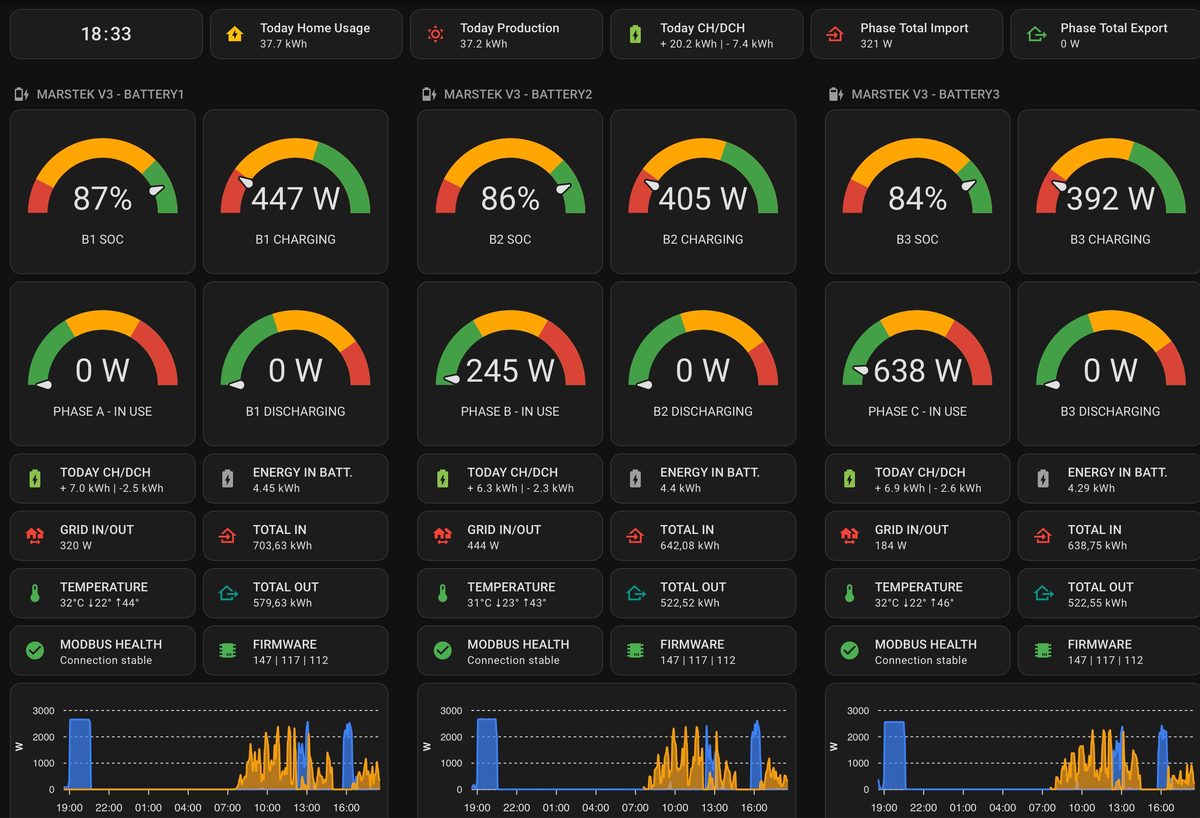
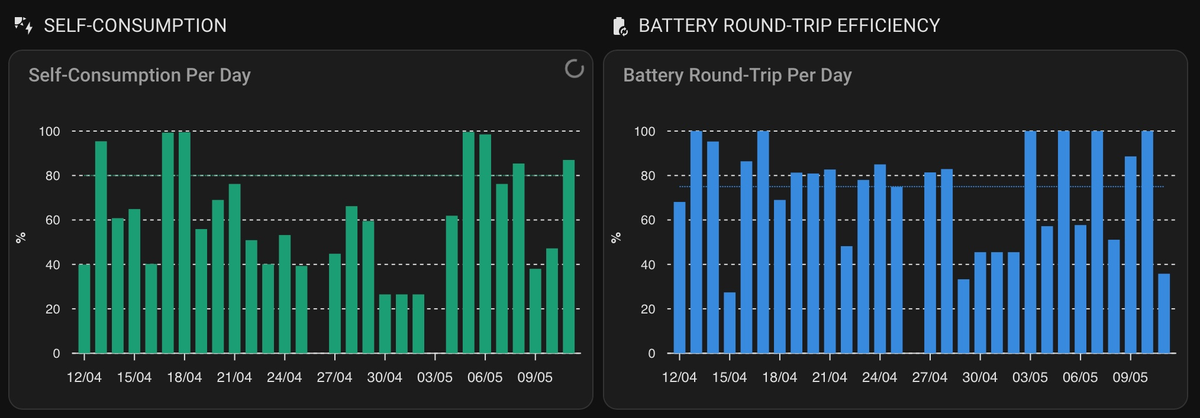
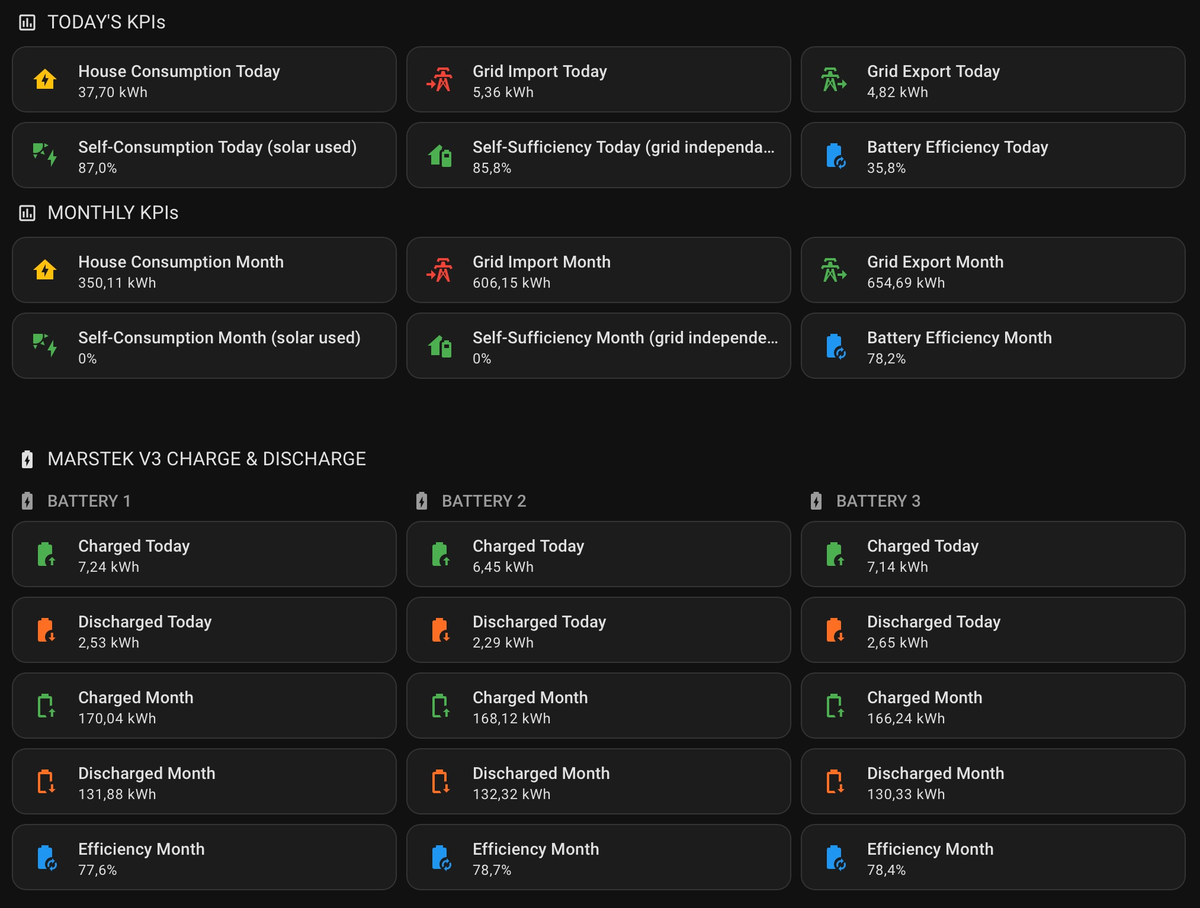
The ROI on the Marstek setup is faster than the Sonnen, simply because the upfront cost is so much lower. On current Belgian tariffs and dynamic price contracts, the three-unit Marstek installation looks set to pay back in roughly five to six years. The Sonnen, at three times the cost per kWh, is on a ten- to twelve-year payback. Whether either of those numbers is "good" depends on how you compare it to alternative investments and how long you expect to stay in the property. For most households, both are clearly positive over the lifespan of the equipment, but the Marstek wins on raw payback time and the Sonnen wins on everything else.
A note on monitoring
The data story matters, but it brings up a small point worth mentioning: home battery data does not currently flow into PVOutput in any standardised way. PVOutput is fundamentally a solar generation and consumption platform, and while it accepts extended data fields (v7 through v12) that can be used to record battery state of charge or charge power, the conventions are not universal and few inverter brands push battery data through the standard upload paths.
In practice, battery data in 2026 lives in three separate places: the manufacturer's own app for the headline metrics, Home Assistant for the granular telemetry, and PVOutput for the production and consumption story alongside. HelioPeak, the iOS app we discussed in the How HelioPeak fits into the picture, reflects this reality by focusing on the solar production and consumption side of the story without pretending to know what the battery is doing. A future version might integrate battery data once the PVOutput conventions stabilise, but for now the honest answer is that battery owners look at three apps to see their full energy picture. This is one of the things the next few years of the platform will need to figure out.
What I would recommend, given the chance to start over
If I were starting from scratch in 2026, knowing what I now know from running both systems for some time, the calculation would go something like this.
For a main residence with a stable household, a long-term ownership horizon, and a budget that can absorb the premium, I would still install a Sonnen or an equivalent premium wall-mounted system. The polish, the warranty, the silent reliability, and the integrated experience are worth the price for a property you intend to live in for fifteen-plus years. The lock-in is the price of admission, and the gains in not thinking about it are real.
For a second property, a holiday home, a rental, or a household that is technically comfortable and wants maximum storage per euro, I would install three or four Marstek Venus E v3 units, run them through Home Assistant via Modbus TCP, and accept that the official software is a work in progress. The payback is faster, the modularity is genuinely useful, and the platform is more capable than the manufacturer markets, once you put the open-source community on the case.
The hybrid inverter route makes sense mainly for new solar installations being designed from scratch, where the inverter selection can be made with the battery in mind from day one.
What does not make sense, in my honest view, is paying premium prices for plug-in batteries from brands that promise polish they have not yet delivered, or paying for hybrid inverter batteries from brands whose software ecosystem you have not investigated. The technology has matured to the point where every category has good options and bad options. The buying decision is more about brand maturity and software trajectory than about the underlying chemistry.
For now, both my systems are running, both are producing the data they were installed to produce, and both are paying for themselves at the rates we expected when we wrote the cheques. That is, in the end, the only test that matters.